News Hook for Media: How to Turn a Company News into a Publication
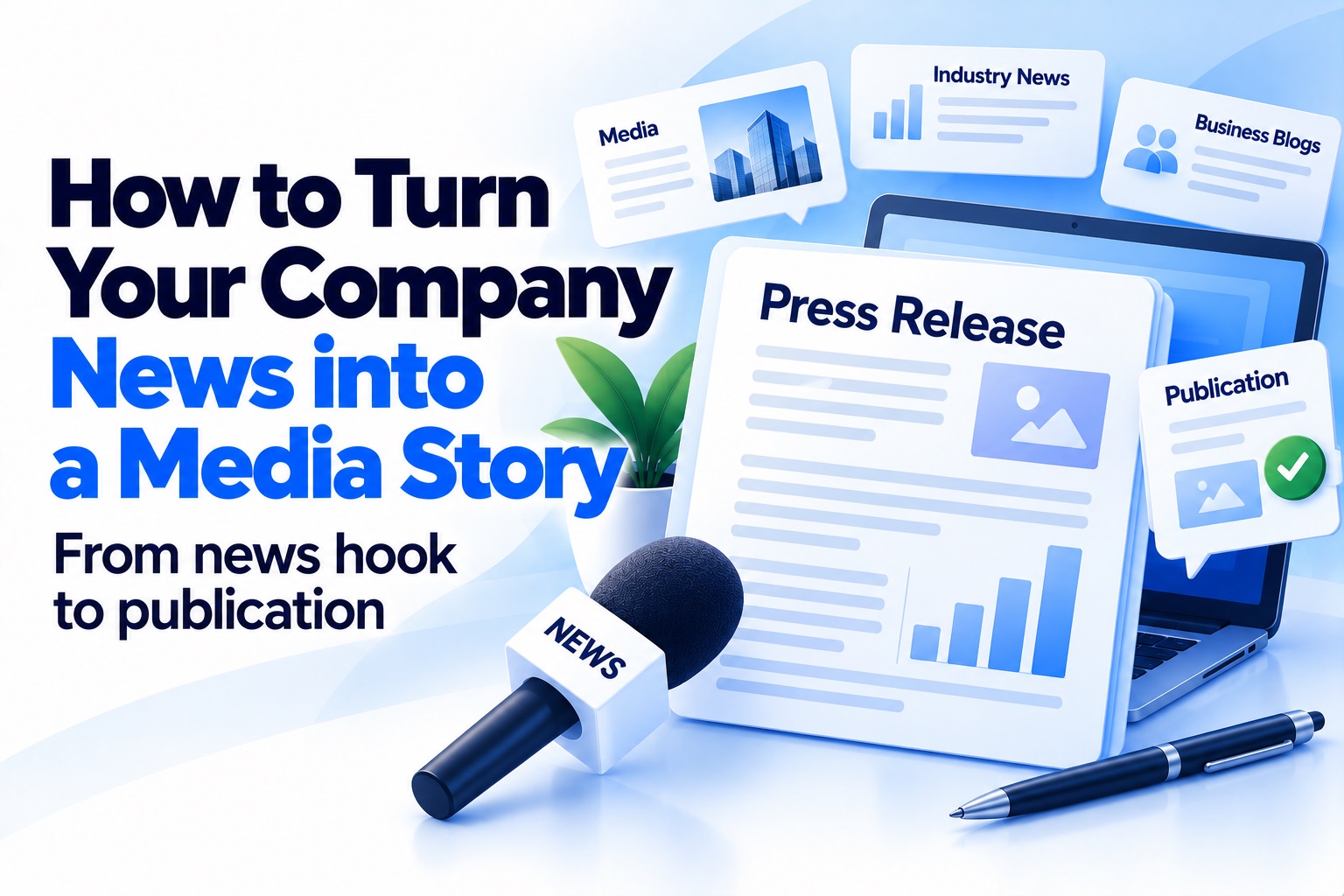
A media news hook is an event, fact, study, or change that may be of interest to the publication’s audience. To turn a company announcement into a publication, it is not enough to simply report on a product launch, office opening, or executive appointment. You need to explain why this information matters to readers, back it up with facts, and offer the journalist a suitable format for the material.
For this, PR specialists analyze the significance of the event, formulate the news angle, prepare a press release, and send it to relevant editorial offices. The clearer the news is formulated, the more reliable the supporting details, and the more accurate the media selection, the easier it is for the journalist to assess the potential value of the material.
However, even a high-quality press release does not guarantee publication: the editorial team independently determines priorities, verifies information, and makes the final decision on whether to publish the material.
What is a media news hook
A media news hook is a news item or significant fact on the basis of which a journalist can prepare material interesting to their audience. It may be related to the company’s activities, but its value must go beyond internal business communication.
For example, a company has opened a new office. For a corporate blog, this might be a reason to talk about business growth. For a business media outlet, the news becomes more interesting if the opening is linked to entering a new market, creating production capacity, investments, or changes in the industry situation.
- Possible sources of news hooks:
- launch of a product or new service;
- expansion into a new region or market;
- results of a study or survey;
- significant changes in the industry;
- new technologies and ways to solve current problems;
- investments, deals, and production expansion;
- expert assessment of an event or trend;
- social, educational, and public initiatives;
- project results confirmed by data;
executive appointments that matter to the market
Not every event requires media publication. The task of a PR specialist is to find facts in the company’s activities that have news value, rather than turning every internal achievement into a loud statement.
What interests journalists
Journalists are interested in topics that are relevant to their audience, contain new facts, and can be verified. News with clear implications, specific data, strong expert commentary, or an original perspective on a significant issue usually holds the most value.
| When evaluating a news hook, it is useful to consider several criteria. | Criterion | Meaning |
|---|---|---|
| Example | Novelty | New information has emerged or a noticeable change has occurred |
| The company launched a technology that solves a previously unaddressed problem | Relevance | The topic is linked to the current agenda or market changes |
| An expert explains the consequences of new requirements for business | Significance | The event affects the audience, industry, or a specific group of people |
| A manufacturer increased capacity to meet growing demand | Verifiability | Information can be confirmed with data, documents, or sources |
| The company publishes the methodology and results of a study | Practical value | The material helps the reader understand the issue or make a decision |
| A specialist explains how to avoid a common mistake | Expertise | There is a competent speaker able to elaborate on the topic |
| A head of an industry project comments on market changes | Visual potential | Photos, charts, diagrams, or videos can be prepared |
The company demonstrates a new production process
These criteria are not a universal formula for editorial decisions. Their importance depends on the type of media, publication format, editorial agenda, and available space.
How to determine if the news hook is strong enough
- Before preparing a press release, ask yourself five questions:
- What exactly happened or changed?
- Why is this important not only to the company itself?
- Who is affected by the event?
- What can confirm the news?
Why should this be reported right now?
If the answers boil down to the company having “become even better,” “presented a unique solution,” or “continued to develop actively,” the news value needs to be clarified.
Instead of general statements, look for specifics: the scale of changes, research results, confirmed metrics, new opportunities for the audience, or the event’s impact on the industry.
Which news hooks suit different media outlets
| The same fact can be presented differently for business, industry-specific, regional, or mass-media publications. The choice depends on the audience’s interests and the editorial format. | Media type | Suitable topics |
|---|---|---|
| Business publications | Investments, deals, market entry, business model changes | Economic context, scale, impact on the market |
| Industry media | Technologies, research, case studies, professional developments | Expertise, solution details, practical applicability |
| Regional media | Facility openings, job creation, local projects, social initiatives | Significance for the region and local residents |
| Technology publications | New products, developments, research, technological solutions | How it works, differentiation from alternatives, proof |
| Consumer media | New services, terms changes, useful recommendations | Practical benefits, clear examples, consequences for consumers |
| Public-political and news editorial departments | Events of public significance, rule changes, current issues | Verifiable facts, public importance, and multiple perspectives |
Do not send the same text to all editorial offices without adaptation. Even if the news hook suits several publications, the angle, headline, and accents may differ.
How to turn a company news item into a strong media hook
To turn an internal news item into a media hook, you need to move from describing the company’s actions to explaining the event’s significance for the external audience. This means that the material should focus not only on business achievements but also on their context, proof, and consequences.
Example 1. Launch of a new product
Weak formulation:
“The company presented an innovative product that is changing the market.”
The problem is that the word “innovative” does not explain what exactly has changed and who benefits from it.
More specific presentation:
“The company launched a service that allows small manufacturers to track shipments in a single interface.”
To turn it into a full-fledged media hook, additional facts are needed: what problem the service solves, how the process works, who the product is available to, what confirms its usefulness, and whether there are testing results.
Example 2. Opening of a new office
Weak formulation:
“The company opened a modern office and continues to develop actively.”
A more substantive option:
“The company opened a regional office to serve clients in three new regions.”
Additional value can be provided by verified data on launch dates, new jobs, logistics changes, or service availability. It is important that these details truly reflect the scale of the event.
Example 3. Market research
Weak formulation:
“The company conducted research and identified important trends.”
A stronger media hook:
“The company’s research showed which factors most often influence supplier selection in a specific market segment.”
For the editorial team to evaluate such news, it is necessary to disclose the methodology: whom they interviewed, how many participants there were, when the research was conducted, how questions were formulated, and what limitations the results have.
Example 4. Expert commentary
Weak formulation:
“The company head shared his opinion on industry development.”
A more substantive presentation:
“An expert explained which changes in the industry could affect delivery costs and timelines.”
A strong comment contains specific thesis points, arguments, and an explanation of consequences. A management title alone is not enough: it is important that the expert really knows the topic and can confirm their conclusions.
The examples show a general principle: a strong media hook reveals a specific change, its significance, and proof, rather than simply reporting on the company’s activities.
How to write a press release for media
A press release is a structured message for editorial offices that helps quickly understand the essence of the news, verify facts, and determine whether the topic is suitable for publication. It should be clear, specific, and focused on the editorial task, not on advertising the company.
A good press release usually includes a headline, lead, details, supporting data, a speaker quote, boilerplate information, and contact details for clarifications.
1. Formulate a news headline
The headline should convey the main event, not advertise the company.
Weak option:
“Company N presents a unique next-generation solution.”
A more specific option:
“Company N launched a service for automating shipment tracking.”
If there is a verified fact that reveals the scale of the event, it can be moved to the headline. However, do not add numbers, comparisons, or promises that cannot be proven.
2. Write the lead – the first paragraph with the main fact
The lead answers the main questions: what happened, who was involved, where and when it took place, and why the event is important.
For example:
“Company N launched a service for automating supply accounting for small manufacturing enterprises. The solution allows tracking order data and delivery deadlines in a single interface; the service is available to customers from [specify launch date or conditions].”
The last part of the example requires specific, verified data. It is necessary to clarify the launch date, target audience, and actual product capabilities before sending the material.
3. Add facts and context
After the lead, explain what preceded the event, what problem it solves, and why it might interest the reader.
Depending on the topic, specify:
- specific characteristics of the event;
- results of research or projects;
- scale of changes;
- participants and partners;
- geography and timelines;
- available documents, data, or links;
- limitations and conditions that are important for the audience to know
Do not overload the text with corporate history. A press release should contain only information necessary to understand this specific news.
4. Use an expert quote
A quote helps explain the significance of the event, reveal its context, or provide a professional assessment.
Weak version:
“We are pleased to present an innovative product that opens new horizons and has no analogues.”
More useful approach:
“When developing the service, we focused on combining order and supply data in one interface. This allows users to find information about order status faster,” explains [name, position].
This example is a template: before publication, the quote must be coordinated with the actual speaker and checked to ensure it accurately reflects their position. You cannot attribute words to a person that they did not say or approve.
5. Specify contacts and additional materials
At the end of the press release, add the name of the contact person, their position, work email address, and other agreed-upon communication methods.
If necessary, attach:
- high-quality photos;
- logos and illustrations with clear usage terms;
- charts and tables;
- a link to research or methodology;
- speaker biography;
- company profile;
- expert contacts for interviews
Materials should be accessible without unnecessary restrictions. If an image or data cannot be used without additional approval, this must be stated in advance.
Press release structure: a template for companies
Below is a universal structure that can be adapted for news, product launches, research, or corporate events.
Headline: [Specific event or result]
Date and location: [Date, city – if relevant to the news]
Lead: [What happened, who was involved, when, where, and why it matters.]
Details: [Event context, facts, figures, conditions, timelines, and other verifiable information.]
Speaker comment: [Agreed quote explaining the significance of the news or its consequences.]
Additional information: [Link to research, photos, technical materials, or other confirmations.]
About the company: [Brief profile necessary for understanding the context.]
Media contacts: [Name, position, email, phone if necessary.]
Text volume depends on the complexity of the news and the specific requirements of the editorial office. Do not artificially inflate the press release for the sake of length: it is better to provide a short, substantive text and additional materials upon request.
How to send a press release to journalists
Press release distribution works best when addressed to publications for which the news is truly relevant, and the email explains the value of the topic. Mass sending of the same text without selecting recipients does not replace working with a media database and personal communication.
Step 1. Compile a list of suitable publications
Select media outlets by theme, geography, audience, and publication format. Look at what materials the publication produces, which topics it covers, and which formats it uses.
It is important not just to find a journalist’s address, but to understand whether the news matches their specialization and editorial agenda.
Step 2. Prepare a personalized email
In the email, briefly explain:
- why you are contacting this particular journalist or publication;
- what the news is about;
- why it might interest their audience;
- what data, documents, or experts are available;
- how quickly additional comments can be obtained
There is no need to rewrite the entire press release in the cover letter. Its task is to explain why the material should be opened and the topic considered.
Step 3. Make the email subject line specific
Instead of “Interesting offer for media,” use a formulation that reflects the news.
For example:
“Research: which factors influence supplier selection in the [market name] segment.”
The subject line should match the content and not create false expectations.
Step 4. Ensure access to facts and spokespeople
If journalists need to clarify information, it is important to quickly provide confirmations and arrange comments from a competent company representative.
Determine in advance who handles requests, when the spokesperson is available, and which questions require additional approval.
Step 5. Track the results of the mailing
Record sent emails, responses, requests for additional information, interviews, and publications. This will help understand which topics and formats generate interest and which require improvement.
A lack of response does not necessarily mean the journalist did not like the news. The editorial office may have other priorities, time constraints, or insufficient space for the material.
How to increase the chances of publication
The combination of a strong news hook, quality facts, relevance to the editorial office, and convenience of working with the source increases the chances of publication. No single technique guarantees material placement, but systematic preparation helps make the offer more useful for the journalist.
What to do before sending:
- Check the newsworthiness. Explain why the event matters to an external audience
- Prepare evidence. Confirm numbers, facts, dates, and claims with documents or reliable sources
- Offer expert commentary. The spokesperson must be ready to discuss the topic and answer clarifying questions
- Select a suitable format. A short news item may be best for one topic, while another may suit an interview, research, or expert column
- Adapt the presentation to the editorial office. Consider the specialization of the publication and the interests of its audience
- Prepare visual materials. Provide photos, charts, or illustrations if they truly help reveal the topic
- Respect editorial independence. Offer facts and expertise, but do not demand publication in a specific wording unless the format allows for advertising placement
It is also useful to check the text for clarity: can someone hearing about the company for the first time understand the news without additional explanations?
Which mistakes reduce the chances of publication
Even a significant event can be presented in such a way that the editorial office does not see suitable material in it.
| Mistake | Why it hinders | How to fix |
|---|---|---|
| Advertising text instead of news | No specific event and public value | Start with a fact and explain its significance |
| General words without proof | Claims of leadership or uniqueness cannot be verified | Add verifiable data and methodology |
| Uninteresting headline | Does not reveal the essence of the event | Formulate exactly what happened |
| Too long press release | The main point gets lost in details | Keep key facts, move the rest to a reference section |
| Mass mailing without selecting media outlets | The topic may not match the editorial audience | Create a targeted list and adapt the email |
| No available spokesperson | Journalists find it difficult to verify facts and get comments | Assign a contact person and agree on expert availability |
| Unconfirmed numbers | Reduces trust in the material | Check the source, period, and calculation method |
| Artificially created sensation | The headline promises more than the material contains | Use precise formulations without exaggeration |
| Mixing editorial and advertising formats | Expectations of parties may not match | Clarify in advance the conditions for editorial review and paid placement |
| Lack of contacts | Editorials find it difficult to request clarifications | Add working contacts and available materials |
It is especially dangerous to exaggerate results or present assumptions as facts. A journalist may request confirmation, and discovered inaccuracies can damage trust in the company.
What to do if media outlets do not publish the news
Rejection or lack of response does not always mean the news hook is unpromising. Before resending the material, you need to evaluate the reason: insufficient newsworthiness, unsuitable editorial office, unclear presentation, lack of confirmation, or lack of relevance.
Possible actions:
- revise the headline and first paragraph;
- add missing data or expert comment;
- offer a different format, for example, an interview instead of a press release;
- choose a more suitable industry or regional media outlet;
- link the topic to a current event, if such a connection really exists;
- prepare an independent analytical material based on data;
- clarify with the journalist what information is needed to consider the topic if the dialogue has already started
Do not repeatedly send the same letter without new facts or changes. A follow-up is justified if a new significant fact has emerged, the data has been updated, or the topic has gained additional relevance.
If the publication does not fit the editorial format, you can consider paid placement, a sponsored special project, or the company’s own channels. However, such formats must be clearly labeled and advertising materials should not be presented as independent editorial publications.
How to evaluate the effectiveness of working with news hooks
The effectiveness of working with news hooks is assessed by the quality of the resulting publications, their alignment with the target audience, and the achievement of communication goals. The sheer number of press releases sent does not indicate how successfully a company interacts with the media.
For evaluation, it is useful to track:
- the number of prepared and sent materials;
- the number of substantive responses from editorial offices;
- the number of requests for additional information and interviews;
- the number of published articles;
- relevance and quality of the platforms;
- accuracy in conveying key messages;
- context of brand mentions;
- available reach and click metrics;
- subsequent inquiries or other targeted actions, if they can be linked to the publications
It is necessary to distinguish between indicators that the company controls and results that depend on the editorial office. For example, preparing a high-quality press release is within the responsibility of the PR team, while the decision of an independent editorial office to publish is not.
To compare results over different periods, use the same calculation methodology and account for differences in topics, platforms, and formats.
When to hire a PR agency
A PR agency can help if a company finds it difficult to independently identify news hooks, prepare materials for editorial offices, and establish systematic media relations. An external team helps assess the potential of a topic, formulate key messages, prepare background information, and organize communication with relevant journalists.
Depending on the task, work may include:
- audit of news hooks and communication agenda;
- development of a PR plan;
- preparation of press releases and expert materials;
- searching for relevant editorial offices;
- organizing interviews and comments;
- supporting publications;
- monitoring mentions and analyzing results
However, a PR agency cannot guarantee the publication of editorial content: the decision remains with the media. The team’s task is to prepare a high-quality proposal, increase its relevance, and professionally organize interaction.
More details about PR support services can be found on the page“PR and Reputation Management”.
Frequently Asked Questions
What is a news hook for the media in simple terms?
A news hook is an event or fact that can interest the audience and serve as the basis for a journalistic piece. It should contain novelty, significance, relevance, or practical value.
How to understand if a company’s news is interesting to journalists?
Check if there is a specific fact in it, why it is important for the audience, whether the information can be verified, and if the topic fits the specialization of the publication. If the material only talks about the company’s advantages, it is worth finding a more significant external context.
How to write a press release for the media?
Start with a specific headline and lead, then detail the specifics, add verifiable data and a coordinated quote from an expert. At the end, provide reference information and media contacts. Remove advertising phrasing and unverified claims.
What should a press release look like?
It should be accurate, clear, structured, and focused on the news. The volume depends on the complexity of the event and the requirements of the editorial office. The main thing is that the journalist can quickly understand the essence, verify facts, and contact a company representative if necessary.
Where to send a press release?
Choose editorial offices that cover the relevant industry, region, or topic. Before sending, study the media’s publications and determine which angle would be useful for their audience.
Why don’t media outlets publish press releases?
Reasons may include low news value, inappropriate topic, lack of facts, advertising presentation, or editorial priorities. Sometimes the editorial office simply lacks the resources to work on the topic. You should check the material and the relevance of recipients, rather than repeating mass mailings without changes.
Is it possible to guarantee publication in the media?
No, if we are talking about an independent editorial publication. The decision is made by the editorial team. Guaranteed placement is possible only within a separately agreed commercial format and under the terms of a specific platform.
How does a press release differ from an advertising material?
A press release reports on news and offers the editorial team facts for independent consideration. An advertising material is created to promote a company or product and is placed under agreed commercial terms. The format and labeling must comply with the platform’s rules and applicable legal requirements.
Glossary
News hook – an event, fact, or change that can serve as the basis for news for a specific audience.
Press release – a structured message from a company to media outlets about an event, fact, launch, research, or other information trigger.
Lead – the first paragraph of the material, which briefly reveals the main event and its significance.
Newsworthiness – the degree of interest in an event for the audience, taking into account novelty, relevance, significance, and other factors.
Media pitch – a targeted offer to a journalist to consider a topic, news, expert comment, or other material.
Editorial publication – a material whose preparation and publication decision is made by the editorial team in accordance with their standards and tasks.
Post-release – a material about an event that has already taken place, such as a conference, event, or project launch.
PR support – a set of communication activities aimed at interacting with media, developing expert positioning, and managing the brand’s information field.
Summary
To turn a company’s news into a publication, you need to find a real news hook, explain its significance to the audience, prepare verifiable facts, and choose suitable editorial teams.
A good press release should not look like an advertising leaflet. It helps the journalist quickly understand what happened, why it is important, and what information is available for verification. Personalized mailing, the expert’s willingness to give a comment, and quality additional materials make interaction with the editorial team more convenient.
However, publication in an independent media outlet is never an automatic result of mailing. Systematic PR work is built on the quality of news, trust in the source, understanding of editorial interests, and readiness to provide the audience with reliable information.
Read also
Negative reviews about the company: how to respond and protect reputation
PR agency or in-house PR manager: what to choose for business
How to evaluate PR effectiveness: metrics, KPIs, and reporting
Brand mention monitoring: how to identify reputational risks