SMM, SEO, PR, and Content Marketing: What’s the Difference and What to Choose for Your Business

SMM, SEO, PR, and content marketing are different areas of marketing that help a company attract customers, increase brand awareness, and build trust. They use different channels and tools: social networks, search engines, media publications, expert materials, and other communication formats.
The main difference lies in the tasks. SMM is responsible for promotion and communication on social media, SEO – for website visibility in search engines, PR – for reputation and public relations, and content marketing – for attracting and retaining an audience through useful content.
These directions do not replace each other. For sustainable business promotion, they are often combined into a single marketing system where each channel solves its own task.
How SMM, SEO, PR, and content marketing differ
SMM, SEO, PR, and content marketing differ in their main communication channels, tools, and expected results. However, they can use the same materials and work towards common business goals.
For example, an expert article can attract organic traffic via SEO, be used on social media for SMM, and become the basis for a PR publication in an industry media outlet.
Brief comparison of directions
| Direction | Main task | Key tools | Expected result |
|---|---|---|---|
| SMM | Promotion and communication on social media | Posts, videos, communities, advertising, audience engagement | Reach, engagement, followers, inquiries |
| SEO | Increasing website visibility in search results | Technical optimization, semantics, content, links, internal linking | Organic traffic, rankings, conversions |
| PR | Building reputation and public perception of the brand | Media outlets, events, expert comments, press releases, crisis communications | Fame, trust, reputation, mentions |
| Content Marketing | Attracting and retaining an audience through useful materials | Articles, research, case studies, videos, newsletters, guides | Expertise, trust, traffic, leads, and retention |
SMM: Promotion on social media
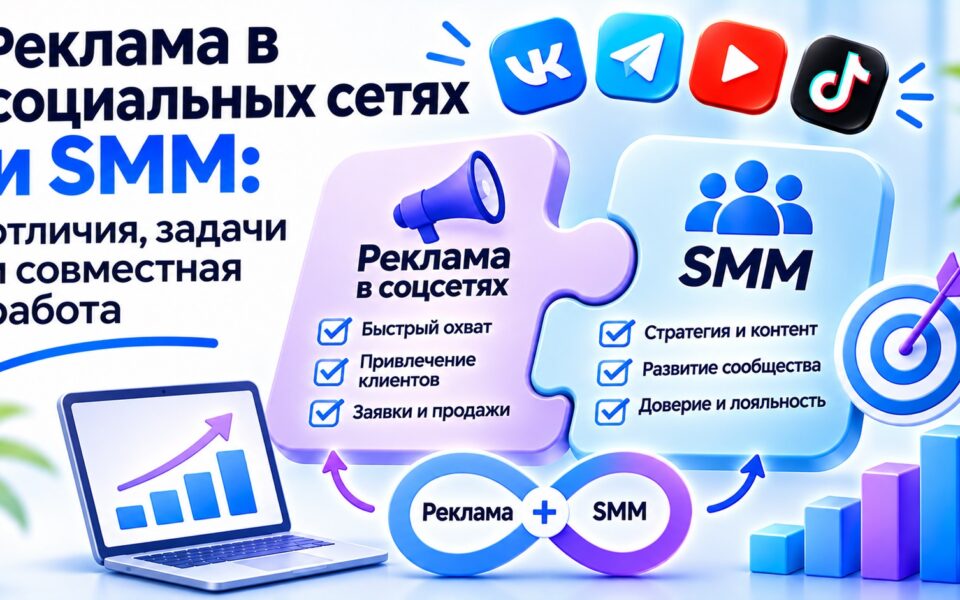
SMM (Social Media Marketing) is marketing on social media. This direction includes creating and distributing content, managing communities, interacting with subscribers, and promoting the brand on social platforms.
Main tasks of SMM:
- increasing company awareness;
- developing communities and channels;
- attracting target audiences;
- generating interest in products and services;
- communicating with clients;
- receiving inquiries and applications;
- supporting sales and loyalty
SMM is not limited to posting. Full-scale promotion includes strategy, audience analysis, content planning, material creation, moderation, advertising, and result evaluation.
For example, a company might use VKontakte to develop a community, Telegram for expert communication, and YouTube for publishing detailed reviews and educational videos.
SEO: Website promotion in search engines
SEO (Search Engine Optimization) is website search engine optimization aimed at increasing its visibility in organic search results.
The main task of SEO is to make the site relevant to user search queries, technically accessible to search engines, and useful for visitors.
Main areas of SEO:
- collecting and clustering search queries;
- technical website audit;
- optimizing structure and pages;
- creating and improving content;
- internal linking;
- working with external links and mentions;
- improving user experience;
- analyzing search traffic and conversions
For example, a user searches for “how to choose a CRM for small business.” The company publishes a detailed article, optimizes it for the search query, and gains the opportunity to attract interested visitors from organic search results.
SEO is particularly useful when potential customers independently search for solutions to their problems. However, search optimization results usually require time and systematic work.
PR: Managing reputation and public communications
PR (Public Relations) is public relations. This direction is responsible for shaping public perception of the company, developing relationships with external audiences, and managing reputation.
PR works not only with clients but also with journalists, industry experts, partners, investors, employees, and other stakeholder groups.
Main PR tools:
- publications in media and industry outlets;
- press releases;
- expert comments;
- interviews and speeches;
- participation in conferences and events;
- partnership projects;
- crisis communications;
- reputation management and mention monitoring
For example, a company develops a new technological solution and organizes expert publications in industry-specific media. This helps to establish the brand’s information presence and increase trust among potential clients and partners.
PR is not limited to purchasing publications. Its task is to build consistent and convincing communications that support the company’s reputation.
Content marketing: attracting an audience with useful content
Content marketing is the systematic creation and distribution of materials that answer audience questions, help solve their tasks, and build trust in the company.
Unlike direct advertising, content marketing does not necessarily offer to buy a product at every touchpoint. It can introduce the audience to a problem, explain possible solutions, and gradually lead them to choose the company.
Main formats:
- expert articles;
- instructions and guides;
- research and analytical reviews;
- case studies;
- e-books and checklists;
- educational videos;
- webinars;
- newsletters;
- podcasts;
- infographics
For example, a company selling project management software might publish instructions on task planning, materials on teamwork, and breakdowns of business processes. Such content attracts interested users and demonstrates the company’s competencies.
Content marketing can work through various channels: website, search engine results, social media, email newsletters, media, and video platforms.
SMM and SEO: what is the difference
SMM and SEO differ primarily in the channel of audience acquisition. SEO works with search demand, while SMM focuses on communication and content distribution on social media.
In SEO, the user usually formulates their own need and searches for information or a product. In SMM, a company can attract the user’s attention even before they start actively searching for a solution.
Comparison of SMM and SEO
| Criterion | SMM | SEO |
|---|---|---|
| Promotion channel | Social networks | Search engines |
| Audience behavior | Interaction with content and community | Searching for information, goods, and services |
| Main tasks | Awareness, communication, engagement, leads | Organic traffic, visibility, conversions |
| Main formats | Posts, videos, stories, publications, live streams | Website pages, articles, categories, product cards |
| Speed of obtaining initial results | Can be relatively fast if there is an existing audience and promotion | Usually requires time for indexing, competition, and accumulating results |
| Main metrics | Reach, ER, ERR, subscribers, clicks, leads | Positions, organic clicks, impressions, CTR, conversions |
| Long-term effect | Community development and constant communication | Accumulation of organic visibility and search traffic |
What to choose: SMM or SEO
The choice depends on the target audience’s behavior and the nature of the product.
You should prioritize SEO if:
- customers actively search for products or services via search engines;
- the company offers solutions with clear search demand;
- the website is an important sales channel;
- it is necessary to attract organic traffic;
- the business is ready to invest in long-term website development
You should prioritize SMM if:
- the product requires visual demonstration;
- it is important to build a community around the brand;
- the company regularly interacts with customers;
- it is necessary to increase awareness;
- the audience actively consumes content on social media
For example, an online store with a large assortment may benefit particularly from SEO for promoting categories and products. At the same time, SMM will help showcase new items, run promotions, and build loyalty.
For most companies, these directions work more effectively together: SEO attracts users with formed demand, while SMM supports interest in the brand and helps stay connected with the audience.
SMM and PR: what is the difference
SMM and PR often overlap since both areas work with communication, awareness, and brand perception. However, their tasks and scope differ.
SMM is primarily responsible for the company’s presence on social media, community development, and interaction with subscribers. PR manages a broader system of public communications: relationships with media, experts, partners, and other audiences.
Comparison of SMM and PR
| Criterion | SMM | PR |
|---|---|---|
| Main task | Promotion on social media | Building reputation and public perception |
| Main channels | Social networks and communities | Media, industry outlets, events, public communications |
| Audience | Subscribers, potential and existing customers | Clients, journalists, partners, experts, public |
| Tools | Content, communities, advertising, moderation | Publications, interviews, press releases, events, comments |
| Key metrics | Reach, ER, followers, clicks, inquiries | Mentions, publication quality, sentiment, media reach |
| Main result | Active presence on social media | Trust, reputation, brand awareness and audience relations |
Can SMM replace PR
No. Social networks can be part of a PR strategy but do not replace all public relations tools.
For example, publishing a post in a company community helps convey information to subscribers. An interview with the company head in an industry publication allows reaching a broader professional audience and strengthening expert status.
At the same time, PR can use social networks to distribute publications, communicate during crises and interact with the public.
Example of joint work:
- The PR team prepares a market research report and organizes its publication in a specialized media outlet
- The SMM team adapts the research results into a series of posts and short videos
- Content marketing turns the research into a detailed article and analytical material on the website
- SEO helps promote the article for relevant search queries
One news item is used by several directions, but each solves its own task.
How content marketing differs from SMM
Content marketing and SMM are closely related since both directions use publications, videos and other materials. However, they differ in scope of application.
Content marketing is responsible for the strategy of creating useful content and working with it across various platforms. SMM is responsible for promotion and communication on social media, including through content.
Comparison of content marketing and SMM
| Criterion | Content marketing | SMM |
|---|---|---|
| Main task | Attract and retain the audience using useful materials | Promote the brand and interact with the audience on social media |
| Channels | Website, blog, newsletters, media, video, social media | Social networks |
| Formats | Articles, research, case studies, guides, webinars | Posts, short videos, stories, live streams |
| Main focus | Content and value of materials | Content, distribution and interaction |
| Metrics | Reads, traffic, subscriptions, leads, engagement | Reach, ER, ERR, followers, clicks, inquiries |
| Result | Expertise, trust, leads and retention | Community development, brand awareness and inquiries |
Can content marketing exist without SMM
Yes. A company can develop content marketing through a blog, email newsletters, industry media, webinars and other channels without actively managing social networks.
Similarly, SMM can be built on news, entertainment formats, user-generated content and direct communications without a separate content marketing strategy.
However, combining these directions allows more efficient use of materials. For example, one expert article can become the basis for several posts, a series of short videos, a newsletter and a presentation.
Marketing and SMM: what is the difference
Marketing and SMM are not equivalent concepts. Marketing represents a broader system for managing demand, supply and company interaction with the market. SMM is one of the areas of marketing activity.
Marketing includes market research, audience and competitor analysis, positioning, product strategy, pricing, promotion, sales and customer retention.
SMM is responsible for a specific part of this system – promotion and communication on social media.
How marketing differs from SMM
| Criterion | Marketing | SMM |
|---|---|---|
| Scale | Entire system of market work | Separate promotion channel |
| Tasks | Demand, positioning, sales, business development | Social networks, audience, content and communication |
| Research | Market, competitors, consumers, product | Audience and social media user behavior |
| Channels | SEO, SMM, PR, advertising, email, offline and others | Social platforms |
| Responsibility | Overall marketing strategy | Implementation of SMM tasks |
| Result | Achievement of marketing and business goals | Results of social media promotion |
How a marketer differs from an SMM specialist
A marketer is responsible for developing and implementing marketing decisions at the product, market and business levels. An SMM specialist is responsible for promoting the company on social media and achieving the goals of this channel.
For example, a marketer determines which audience to target with the product, how it differs from competitors, and which channels will help increase sales. An SMM specialist develops a content plan based on this strategy, manages communities, interacts with subscribers, and analyzes social media results.
| Task | Marketer | SMM Specialist |
|---|---|---|
| Market Analysis | Primary area of responsibility | Uses results for SMM |
| Audience Segmentation | Develops or coordinates | Refines social media segments |
| Positioning | Determines jointly with the business | Adapts communication |
| Marketing Strategy | Develops and coordinates | Implements part of the strategy |
| Social Media Content Plan | Defines general directions | Develops and manages |
| Posts | May control | Prepares and publishes |
| Analytics | Evaluates overall marketing results | Analyzes SMM metrics |
| Sales | Works with the overall marketing system and demand | Influences through social channels |
In a small company, one specialist may combine several functions. However, as the business grows, marketing and SMM tasks are usually divided among different employees.
What is the difference between a content manager and an SMM manager
A content manager and an SMM manager work with company materials, but their areas of responsibility differ.
A content manager is responsible for organizing, preparing, publishing, and maintaining the relevance of content on specific platforms. This can include a website, online store, blog, catalog, or social networks.
An SMM manager specializes in promoting and managing social networks. They not only publish posts but also work with strategy, audience, engagement, and channel results.
Comparison of content manager and SMM manager
| Criterion | Content Manager | SMM Manager |
|---|---|---|
| Main Task | Managing content on platforms | Promotion in social networks |
| Main Platforms | Websites, blogs, catalogs, social networks | Social Networks |
| Text Work | Preparation and publication | Preparation and adaptation for social networks |
| Visual Materials | Organizing placement and updates | Preparing or coordinating content creation |
| Strategy | Content organization and editorial process | SMM Strategy |
| Analytics | Views, relevance, content effectiveness | Reach, ER, ERR, subscribers, inquiries |
| Communication | May not be included in duties | Usually included in tasks |
For example, an e-commerce content manager updates product cards, descriptions, images, and categories. An SMM manager prepares posts about products, organizes community promotion, and interacts with subscribers.
However, job responsibilities may overlap in different companies. Therefore, when hiring, it is important to evaluate not only the job title but also the specific list of tasks.
Difference between a content maker and an SMM specialist
A content maker (Content Creator) is a specialist who creates materials for digital platforms: photos, videos, texts, graphics, and other formats.
An SMM specialist is responsible for promotion in social networks. They may create content themselves, but they can also assign tasks to designers, copywriters, videographers, and content makers.
Comparison of content maker and SMM specialist
| Criterion | Content Maker | SMM Specialist |
|---|---|---|
| Main Focus | Creating materials | Promotion and development of social networks |
| Key Tasks | Photos, videos, texts, visual concepts | Strategy, posts, audience, analytics |
| Working with Audience | Creates materials for them | Analyzes and develops interaction |
| Planning | Content production plan | Content plan and SMM strategy |
| Metrics | Quality, deadlines, and content effectiveness | Reach, engagement, clicks, and inquiries |
| Responsibility | For material production | For SMM direction effectiveness |
For example, a content maker shoots and edits video clips about a product. An SMM specialist determines which social networks they are needed for, what tasks they should solve, how often to publish, and by which indicators to evaluate results.
In small teams, one person may perform both functions. However, for large-scale projects, dividing roles helps improve production quality and systematic promotion.
Difference between a targetologist and an SMM specialist
A targetologist is a specialist in setting up and optimizing paid advertising in social networks and other ad systems that support audience targeting.
An SMM specialist handles broader promotion in social networks: content, community management, communication, audience development, and analytics.
Comparison of targetologist and SMM specialist
| Criterion | Targetologist | SMM Specialist |
|---|---|---|
| Main Task | Managing paid ad traffic | Developing brand presence in social networks |
| Main Tool | Ad accounts | Content, communities, communication and promotion |
| Audience engagement | Segmentation and ad targeting setup | Interest analysis and community development |
| Creatives | Preparation and testing of ad creatives | Content for regular communication |
| Budget | Planning and optimization of advertising expenses | Can coordinate promotion within SMM |
| Key metrics | CPM, CPC, CTR, CPL, conversions, ROAS | Reach, ER, ERR, follower growth, clicks, inquiries |
Do you need a targetologist if you already have an SMM specialist
It depends on the company’s tasks and team composition. If the business needs to systematically attract paid traffic, test audiences, and optimize the advertising budget, a separate advertising specialist may be useful.
At the same time, the SMM specialist and the targetologist should work together. The first ensures the content and communication aspects, while the second helps scale promotion using paid advertising.
For example:
- The SMM specialist analyzes the audience and prepares content
- The targetologist selects ad segments and tests creatives
- The team compares the results of paid and organic posts
- Based on data, offers, content, and ad campaigns are adjusted
SMS marketing vs. SMM: what is the difference
SMS marketing and SMM are often confused due to similar spelling, but they are different communication channels.
SMS marketing involves sending short text messages to users’ mobile phones. SMM is promotion and communication through social networks.
Comparison of SMS marketing and SMM
| Criterion | SMS marketing | SMM |
|---|---|---|
| Channel | Mobile SMS | Social networks |
| Format | Short text messages | Posts, videos, images, stories, live streams |
| Audience | Users with available phone numbers and necessary consent for mailing | Subscribers and users of social platforms |
| Main tasks | Notifications, promotions, reminders, stimulating repeat purchases | Brand awareness, communication, engagement, customer acquisition |
| Personalization | Based on contact database and customer data | Through segmentation and personalized content |
| Feedback | Limited by SMS format | Comments, messages, reactions, discussions |
| Key metrics | Delivery, clicks, conversions, unsubscribes | Reach, ER, ERR, CTR, clicks, leads |
SMS marketing is well suited for service notifications, appointment reminders, order change notifications, and personalized offers. SMM helps maintain a constant brand presence and build relationships with the audience.
These channels can complement each other. For example, a company publishes a promotion on social media and then sends a personalized SMS message to customers who have consented to receive promotional messages.
When using SMS mailings, it is necessary to comply with legislation on personal data and advertising, including rules for obtaining consent for promotional messages.
Influencer marketing vs. SMM: what is the difference
Influencer marketing is brand promotion through content creators, bloggers, opinion leaders, and other people who have influence over a specific audience.
SMM is a broader direction that includes managing a company’s own social media accounts and promoting them.
Influencer marketing can be part of an SMM strategy, but is not limited to the brand’s own accounts.
Comparison of Influencer Marketing and SMM
| Criterion | Influencer Marketing | SMM |
|---|---|---|
| Main channel | Bloggers and content creators | Company’s own accounts |
| Main resource | Audience and trust in the author | Brand content, community, and communication |
| Tools | Integrations, reviews, recommendations, ambassadorship | Posts, videos, communities, ads |
| Main task | Access to the author’s audience and influence on their choice | Constant development of the brand’s presence on social media |
| Content control | Agreed upon with the author and cooperation terms | Mainly controlled by the company |
| Metrics | Reach, views, engagement, clicks, promo codes, sales | Reach, followers, ER, ERR, inquiries, conversions |
When does a business need Influencer Marketing
Influencer marketing is particularly useful when a company needs to:
- quickly introduce a new audience to a product;
- get recommendations from authors trusted by subscribers;
- show the product in real use;
- enter a new thematic niche;
- increase the number of brand mentions;
- test demand for a new product category
For example, a sports nutrition manufacturer may collaborate with niche authors who demonstrate the product and share their personal experience using it. At the same time, the company’s own SMM account continues to publish expert materials, answer questions, and provide product information.
When evaluating integration effectiveness, it is important to consider not only the blogger’s reach but also audience quality, actual traffic, promo codes, leads, and sales.
How to choose a promotion direction for business
Choosing between SMM, SEO, PR, and content marketing depends on the product, target audience, competitive landscape, budget, and company goals.
There is no universal channel that works equally well for any business. For one company, search demand may be the priority; for another, visual communication; for a third, reputation and expert positioning.
Which tool to choose depending on the task
| Business task | Priority direction | Additional tools |
|---|---|---|
| Increase organic website traffic | SEO | Content marketing |
| Grow a community around the brand | SMM | Influencer Marketing, PR |
| Increase trust in the company | PR | Content marketing, SMM |
| Attract clients from search engines | SEO | Content marketing |
| Promote a visual product | SMM | Influencer Marketing |
| Develop expertise | Content marketing | PR, SEO |
| Generate repeat inquiries | Email and SMS marketing | SMM, CRM marketing |
| Manage reputation | PR and reputation marketing | SMM, mention monitoring |
| Attract paid traffic | Targeted and contextual advertising | SMM, SEO |
| Launch a new product | Integrated marketing | PR, SMM, SEO, advertising |
What small businesses should choose
Small businesses usually need to avoid spreading their budget across too many channels. It is better to identify the main client acquisition source and gradually add other tools.
For example:
- a local service provider may benefit from a combination of local SEO, reviews, and social media;
- a small online store may use SEO for categories and products, SMM to showcase products, and ad campaigns;
- a B2B company may rely on expert content, SEO, PR, and professional communications;
- an educational project may use content marketing, SMM, webinars, and partnerships with experts.
The key principle is to choose tools not based on popularity, but on how the target audience makes purchasing decisions.
What B2B companies should choose
In the B2B segment, the sales cycle is often longer, and purchasing decisions may involve multiple people. Therefore, it is important for businesses not only to attract attention but also to build trust and demonstrate expertise.
The following combination is often effective:
| Direction | Role in B2B promotion |
|---|---|
| SEO | Attracting users with specific search intent |
| Content marketing | Explaining complex products and demonstrating expertise |
| PR | Building reputation and presence in industry media |
| SMM | Supporting communication and distributing expert content |
| Email marketing | Managing the database and nurturing potential clients |
For example, a company offering corporate software may publish expert articles on its website, post case studies, participate in industry events, and distribute materials via social networks.
How to integrate SMM, SEO, PR, and content marketing
The most sustainable approach is not to contrast these directions but to build an integrated system where they reinforce each other.
Consider an example of a company providing business process automation services.
- Step 1.Research and positioning. The marketer analyzes the audience, competitors, demand, and product advantages.
- Step 2.Content marketing. The team prepares expert articles, guides, research papers, and case studies that address potential clients’ questions.
- Step 3.SEO. Materials are optimized for search queries, and site structure helps users find the information they need.
- Step 4.SMM. Expert materials are adapted into posts, short videos, discussions, and other formats for social networks.
- Step 5.PR. Company experts speak at events, give interviews to industry publications, and participate in sector projects.
- Step 6.Analytics. The team evaluates traffic, reach, engagement, inquiries, conversions, and the contribution of each channel.
As a result, the company obtains not a set of disjointed activities but a unified marketing system.
How to organize work for marketers, SMM specialists, and other employees
When a business develops multiple promotion channels, it is important to properly distribute responsibilities. Otherwise, specialists may duplicate tasks or work toward different goals.
Example of role distribution:
| Specialist | Main area of responsibility | Work results |
|---|---|---|
| Marketer | Marketing strategy, audience, positioning, channel coordination | Overall promotion system |
| SEO specialist | Search engine optimization of the website | Organic visibility and traffic |
| SMM specialist | Social media, content and communication | Development of social channels |
| PR specialist | External communications and reputation | Publications, mentions, trust |
| Content manager | Organization and publication of materials | Relevance and accuracy of content |
| Content creator | Creation of photos, videos, and other materials | Ready-made content materials |
| Targeting specialist | Paid advertising and its optimization | Advertising traffic and target actions |
| Influencer Marketing Manager | Working with bloggers and authors | Integrations and collaboration results |
In a small company, one employee may combine several roles. For example, an SMM specialist can independently write texts and create simple visual materials. In a large project, these tasks are usually distributed among several specialists.
It is important that each direction has defined tasks, performance indicators, deadlines, and areas of responsibility.
How to evaluate the effectiveness of different marketing directions
Each tool requires its own metrics. You cannot evaluate SEO solely by the number of subscribers or PR exclusively by leads.
| Direction | Key metrics | Additional metrics |
|---|---|---|
| SMM | Reach, ER, ERR, subscribers, clicks, leads | Saves, reposts, mentions |
| SEO | Organic traffic, clicks, impressions, positions | Conversions, visibility, landing page quality |
| PR | Mentions, publication quality, media reach | Tone, Share of Voice, expert invitations |
| Content marketing | Views, organic traffic, subscriptions, leads | Engagement time, reads completion, downloads |
| SMS marketing | Delivery, clicks, conversions | Unsubscribes, repeat purchases |
| Influencer Marketing | Reach, views, clicks, promo codes | Cost per acquisition, sales, audience quality |
It is important to consider that different channels may influence the same sale. For example, a client first saw a blogger’s post, then read an article in search, subsequently subscribed to a Telegram channel, and submitted a lead request.
Therefore, when evaluating comprehensive marketing, it is useful to use UTM tags, web analytics, CRM, and attribution models. They help better understand the user journey, although no model always reflects the full contribution of each brand touchpoint.
FAQ: common questions about SMM, SEO, PR, and marketing
What is the difference between SMM and PR?
SMM is responsible for promotion and communication on social media, while PR focuses on building the company’s reputation and relationships with the public. SMM can be part of a PR strategy, but PR also includes work with media outlets, experts, events, and external audiences.
What is the difference between SMM and SEO?
SMM promotes a company through social networks, while SEO increases the website’s visibility in search engines. SMM helps build communities and facilitate communication; SEO attracts users through organic search results.
How does content marketing differ from SMM?
Content marketing is a strategy for creating and distributing useful materials across various channels. SMM is the promotion and interaction with the audience on social media. Content marketing can use SMM as one of the channels for material distribution.
How does a marketer differ from an SMM specialist?
A marketer is responsible for a broader promotion system: market analysis, audience research, positioning, and marketing strategy. An SMM specialist is responsible for developing social networks and implementing tasks within this channel.
How does a content manager differ from an SMM manager?
A content manager organizes the preparation, publication, and relevance of materials across various platforms. An SMM manager specializes in social media, including strategy, content, communication, and analytics.
Content creator vs. SMM specialist: who does what?
A content creator produces photos, videos, texts, and other materials. An SMM specialist plans and organizes promotion on social media, defines content tasks, and evaluates their effectiveness.
Targeting specialist vs. SMM specialist: what is the difference?
A targeting specialist sets up and optimizes paid advertising, while an SMM specialist is responsible for broader promotion on social media. They can work in the same team and complement each other.
SMS marketing vs. SMM: which to choose?
SMS marketing is suitable for notifications, reminders, and personalized offers to your customer base. SMM is better suited for building a community, increasing brand awareness, creating content, and maintaining constant communication with the audience. The choice depends on the specific task, and these channels can be used together.
Influencer Marketing vs. SMM: What’s the Difference?
Influencer Marketing leverages the audiences of bloggers and opinion leaders to promote a brand. SMM focuses on developing the company’s own social media channels. Influencer marketing can be part of an overall SMM strategy.
Can you promote a business using only SMM?
Yes, in certain niches, social networks can serve as the primary channel for attracting and communicating with customers. However, relying on a single platform increases risks. As the business grows, it is beneficial to integrate a website, SEO, content marketing, and other suitable channels.
Which marketing direction should be chosen first?
Start by analyzing the product, target audience, and buyer behavior. If customers actively search for services online, consider SEO. If the product requires visual demonstration and constant interaction, choose SMM. If establishing expertise and trust is important, opt for content marketing and PR.
Glossary: Key Terms
| Term | Definition |
|---|---|
| SMM | Social Media Marketing |
| SEO | Search Engine Optimization |
| PR | Public Relations and External Communications Management |
| Content Marketing | Content Marketing – attracting and retaining an audience through valuable materials |
| Influencer Marketing | Promotion through bloggers and opinion leaders |
| SMS Marketing | Promotion and communication via SMS messages |
| Targeted Advertising | Targeted advertising for selected audience segments |
| SMM Manager | Specialist in social media promotion |
| Content Manager | Specialist in organizing and publishing content |
| Content Creator | Author and creator of digital materials |
| Marketer | Specialist in marketing strategy and business promotion |
| Targetologist | Specialist in setting up and optimizing targeted advertising |
| CTA | Call to Action |
| KPI | Key Performance Indicators |
| ORM | Online Reputation Management |
| SERM | Search Engine Reputation Management |
Conclusion
SMM, SEO, PR, and content marketing address different tasks but together form a unified system for business promotion.
SEO helps attract an audience from search engines, SMM develops the company’s presence on social media, PR builds reputation and public trust, while content marketing provides the audience with useful materials at various stages of the decision-making process.
Choosing among these directions should not be based on popularity, but rather on the product, target audience, competitive landscape, and business goals. For sustainable growth, a coordinated effort across multiple channels is usually required rather than relying on a single tool.
Nova Media helps companies build comprehensive promotion strategies: from marketing strategy and content marketing to SEO, SMM, PR, and analytics.
Learn more about our services:Nova Media – Marketing and Business Promotion.