Expert Promotion: How to Become a Visible Specialist in Your Industry
Expert promotion is a systematic approach to building a professional reputation, public presence, and brand recognition within your industry. It helps convey expertise to the target audience through interviews, articles, media comments, and professional events.

Expert PR: how to become a visible specialist in sw. Part 1 of 6.
Expert PR is systematic work on a specialist’s professional reputation, public presence, and recognition within their industry. It helps convey competencies to the target audience through interviews, opinion columns, media comments, professional events, and other communication formats.
In this article, we will discuss how to organize expert PR, develop a personal brand, interact with journalists, secure speaking opportunities, and evaluate PR activity results.
What is expert PR?
Expert PR is a set of communication actions aimed at increasing a specialist’s visibility and strengthening trust in their professional competencies. Unlike standard product promotion, it focuses primarily on knowledge, experience, positioning, and the expert’s ability to solve problems for their audience.
Expert PR may be relevant for:
- business owners and CEOs;
- department heads and top managers;
- consultants and independent specialists;
- representatives of technology and professional firms;
- doctors, lawyers, financial experts, and other industry specialists – taking into account communication requirements specific to each field;
- startup founders and heads of new business lines
For entrepreneurs, expert status can help build trust in the company. For independent specialists, it increases visibility and expands professional opportunities. For executives, it strengthens public positioning and enables representing the company in industry discussions.
However, expert PR does not mean that a specialist must constantly be present on all social media platforms or strive to become a celebrity. It is far more important to be visible in those professional communities and channels where the target audience resides.
Why should a specialist develop a personal brand?
A personal brand helps the audience understand the expert’s specialization, experience, and the areas in which they should seek advice. It develops gradually through consistent messaging, professional content, public speaking, and tangible work results.
Expert PR addresses several key tasks.
1. Increases visibility. Potential clients, partners, and colleagues encounter the specialist’s name more frequently in relevant professional contexts.
2. Confirms competencies. Interviews, articles, analytical commentary, and case studies demonstrate how well the expert understands complex issues.
3. Helps stand out from competitors. A distinct professional position and recognizable specialization make the specialist’s image clearer and more defined.
4. Creates new opportunities. Public presence can lead to event invitations, participation in industry projects, and new professional contacts.
5. Supports business development. For executives or owners, a personal brand can complement corporate PR and help the audience better understand the company’s approach and expertise.
6. Builds long-term reputation. Regular substantive content helps reinforce professional associations, provided they align with the specialist’s actual experience.
A personal brand does not guarantee increased sales, fame, or media features. Its practical value depends on how closely public positioning aligns with real competencies and the interests of the target audience.
Where to start promoting an expert?
Promoting a personal brand should begin not with publishing the first post, but with defining professional specialization, target audience, and goals. This allows you to choose appropriate topics and avoid spreading resources across random activities.
Step 1. Define specialization and positioning
Positioning answers the question of which tasks, topics, and professional qualities the audience should associate with the expert.
To develop it, you need to define:
- the core area of expertise;
- the problems the specialist helps solve;
- the target audience;
- distinctive features of the professional approach;
- experience and facts confirming competencies;
- topics the expert is willing to speak about publicly on a regular basis
For example, the formulation “marketing expert” is too broad. A more specific positioning might sound like this: “specialist in search engine promotion for B2B companies and brand visibility development in artificial intelligence systems.”
Specific specialization helps editorial offices, event organizers, and potential clients quickly understand which issues they can turn to the expert about.
Step 2. Define the target audience
Different audiences have different interests and trust criteria. Potential clients value practical solutions, journalists value timely comments and verifiable facts, and the professional community values new ideas and substantive discussion.
Segmentation example:
| Audience | What matters to them | Suitable formats |
|---|---|---|
| Potential clients | Practical benefit, problem solving, proven experience | Case studies, interviews, applied articles |
| Journalists | Quick and substantive comments, facts, expert availability | Expert comments, interviews, analytical materials |
| Professional community | Industry trends, methodologies, experience sharing | Author columns, conferences, roundtables |
| Partners and managers | Professional stance, competencies, market understanding | Business publications, speeches, industry discussions |
| Potential employers or investors | Experience, specialization, results, and professional connections | Public speaking, interviews, expert publications |
At the start, it is sufficient to choose one or two priority audiences. As the expert presence develops, the strategy can be expanded.
Step 3. Formulate key topics
Key topics are the questions around which the specialist wants to regularly share knowledge and reinforce their professional specialization.
To begin, it is useful to define three groups of topics:
- Core expertise: key questions in which the specialist has confirmed knowledge
- Audience’s practical tasks: typical problems, errors, and ways to solve them
- Industry changes: new technologies, market trends, research, and events that the expert can professionally explain
A thematic matrix is formed from these directions. It helps prepare articles, comments, interviews, and speeches without constantly searching for ideas from scratch.
Step 4. Prepare an expert dossier
An expert dossier is a set of materials that simplifies acquainting with the specialist’s professional experience and interaction with editorial offices.
It may include:
- a brief and extended biography;
- description of specialization and key competencies;
- list of topics for comments and interviews;
- verified case studies and results;
- photos for publications;
- links to previous materials and speeches;
- contact for quick communication;
- information on the expert’s availability and comment preparation timelines
Such a dossier helps respond faster to requests from journalists and event organizers. At the same time, it is important to regularly update the information and not include unverified achievements.
What tools are used for expert promotion?
Expert promotion is built on a combination of formats that allow revealing the specialist’s competencies from different angles. The choice depends on the audience, specialization, available time, and communication goals.
| Tool | Main task | What needs to be prepared |
|---|---|---|
| Interviews | Reveal experience, views, and professional stance | Topics, biography, key points |
| Author columns | Show independent expertise and argumentation | Article idea, structure, facts, and examples |
| Expert comments | Respond quickly to current events | Thematic specialization and expert availability |
| Public speaking | Present expertise to a professional audience | Topic, points, presentation, and speech format |
| Industry research | Demonstrate analytical competencies | Methodology, data, and conclusions |
| Professional events | Develop connections and participate in industry discussions | Speech topics and proposals to organizers |
| Own publications | Regularly reveal professional stance | Content plan and editorial standards |
These tools do not necessarily need to be used simultaneously. For a specialist who is just starting public promotion, it is reasonable to choose one main format and one additional one, then expand the program based on results.
How to get into media with an expert comment?
Expert commentary is a specialist’s opinion on a current topic that helps journalists uncover an event, explain a trend, or clarify a complex issue. To gain such opportunities, you need to make your expertise clear to editorial offices and be ready to provide substantive answers within appropriate timeframes.
1. Choose topics you are ready to comment on
Create a list of several areas in which the specialist can confidently explain causes, consequences, and possible solutions.
For example, a finance expert can comment on changes in financial conditions, while a technology specialist can explain the impact of new solutions on business processes.
Do not try to comment on all industry news. Narrow specialization increases clarity of positioning and helps avoid superficial or unverified statements.
2. Find relevant publications and journalists
Study which media regularly publish materials on your topic, who writes about relevant issues, and which experts already participate in discussions.
You can prepare a media map indicating publications, sections, journalists, publication topics, and available contact methods.
3. Prepare a pitch for the editorial office
In a short message, specify the expert’s specialization, topics they are ready to comment on, and contact methods. It is useful to include links to previous publications, if any.
For example:
“Hello! I specialize in marketing automation in B2B. I can promptly comment on topics related to AI application, marketing analytics, and changes in team workflows. If needed, I am ready to provide practical examples and explain the limitations of relevant solutions.”
The pitch should match the specific journalist’s specialization. Mass mailing identical messages is usually less effective than targeted communication with relevant editorial offices.
4. Respond quickly and concisely
Journalists often need comments within tight deadlines. Therefore, it is important to pre-arrange who handles requests, how quickly the expert can respond, and which questions require additional verification.
A good comment contains a specific thesis, explanation, and, when appropriate, supporting data or a practical example. General phrases and promotional company descriptions rarely help develop the topic.
Publication depends on editorial decisions. Even a high-quality comment does not guarantee inclusion in the material, so expert promotion requires consistent work with various opportunities.
How to write op-eds and expert articles?
An op-ed allows a specialist to present their professional stance, explain a complex issue, and offer an argumented perspective on an industry problem. Unlike brief comments, this format provides more space for analysis and practical recommendations.
How to choose a topic for an op-ed?
A good topic lies at the intersection of three factors:
- the author’s professional competence;
- target audience interest;
- a current issue or unresolved industry problem
Instead of a broad topic like “The Future of Marketing,” choose a specific question: “What data does a B2B company need to assess the contribution of content marketing to sales.”
A specific topic helps formulate a thesis, define structure, and explain to the editor why the material will be useful to readers.
How to structure the article?
A practical structure for expert material includes:
- Problem. Explain what issue the audience faces and why it matters
- Main thesis. Formulate the key conclusion developed in the article
- Arguments. Show causes, mechanisms, and limitations of the discussed issue
- Examples and data. Use verified facts, practical observations, and case studies
- Recommendations. Offer specific actions applicable under relevant conditions
- Conclusion. Summarize and highlight what is important to consider when making decisions
An op-ed should not turn into a promotional presentation. Mentioning the company and products is acceptable in the appropriate context, but the main value for the editorial office and reader lies in the content of the material.
How to promote an expert through public speaking?
Public speaking helps specialists present their expertise to a professional audience, answer questions, and participate in industry discussions. For effective promotion, it is important to choose events where the target audience is present and the speech topic aligns with the expert’s specialization.
Working with speeches involves several stages.
1. Identifying suitable events. Study conferences, industry forums, professional communities, webinars, and round tables.
2. Preparing topics. Formulate several reports, each of which addresses a specific issue and contains practical conclusions.
3. Preparing the proposal for the organizer. Briefly describe the topic, its benefit to the audience, speech key points, and the speaker’s professional experience.
4. Preparing the content. Develop the report structure, verify data, prepare the presentation and answers to potential questions.
5. Using the results. After the event, you can write an article on the topic of the speech, publish the main conclusions, and continue the discussion in professional channels.
Not every speech leads to new clients or publications. Therefore, choose events taking into account the target audience, program content, participation format, and time costs.
How to create a content plan for personal brand promotion?
A content plan helps turn expert promotion into a regular process. It combines topics, formats, platforms, and publication schedules so that the specialist’s professional position is revealed consistently.
To start, you can use a simple matrix:
| Direction | Topic examples | Formats |
|---|---|---|
| Professional expertise | Methods, approaches, analysis of complex issues | Author’s articles, comments |
| Practical experience | Cases, mistakes, conclusions from projects | Interviews, publications, speeches |
| Industry analytics | Trends, changes, forecasts with justification | Media comments, analytical columns |
| Professional position | Work principles, reasoned opinion | Author’s columns, discussions |
| Answers to audience questions | Common problems, analysis of typical situations | Articles, webinars, videos |
| Public activity | Participation in events, new publications | Announcements, reviews, expert comments |
It is important to take into account that the same topic can be used in several formats if the material is adapted for the audience and platform requirements. For example, a speech can become the basis for an article, and the key conclusions of an article can become the topic for a comment to a journalist.
At the same time, there is no need to artificially increase the number of publications for the sake of regularity. It is better to release substantive materials at a pace that allows maintaining quality and confirming the professional position.
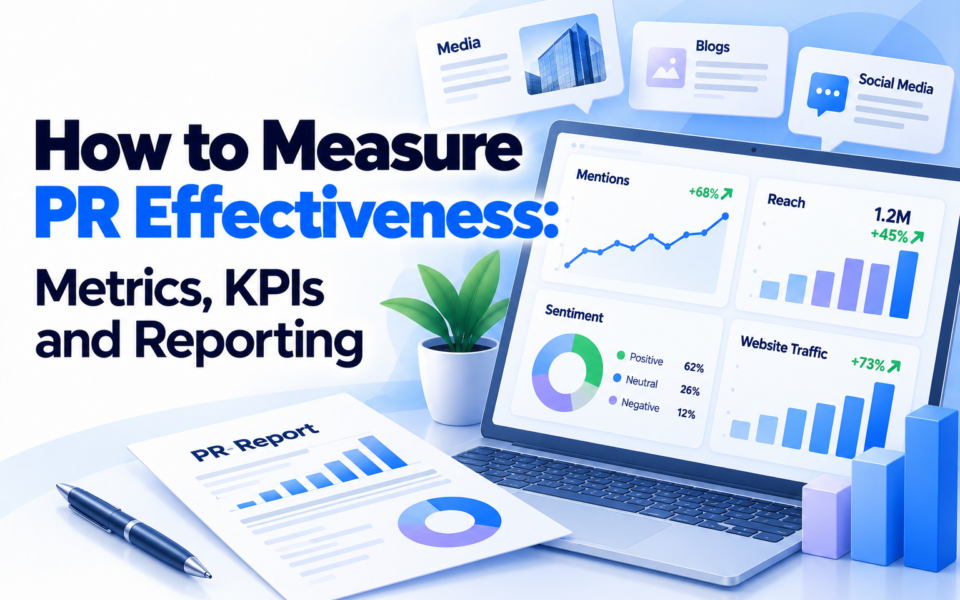
How to evaluate the effectiveness of expert promotion?
The effectiveness of expert promotion is assessed by how much public activity corresponds to the set goals and what changes can be confirmed by data. The number of subscribers or publications itself does not show whether the specialist’s professional reputation has strengthened.
Before launching promotion, it is necessary to determine what result the expert expects: awareness, professional contacts, invitations to events, requests for comments, or inquiries from potential clients.
| Goal | Possible indicators |
|---|---|
| Increasing awareness | Number of relevant mentions, available reach, dynamics of branded queries (if data is available) |
| Developing expertise | Quality of publications, number of interviews and expert comments, presence of key topics |
| Expanding professional connections | New contacts, invitations for cooperation, participation in profile discussions |
| Developing public speaking | Number of speeches, relevance of events to the target audience, feedback |
| Attracting clients | Inquiries from tracked sources, mentions of expert materials in communication with clients |
| Reputation development | Dynamics of mentions, nature of feedback, results of research or surveys (if conducted) |
For measurement, it is useful to keep a registry of publications and speeches, record links, dates, platforms, and available indicators. If expert promotion is related to commercial tasks, you can use transition tags, web analytics, and CRM data.
When interpreting results, it is important to take into account limitations. Audience growth does not guarantee trust growth, a publication does not necessarily lead to an inquiry, and a coincidence in time between public activity and sales growth does not prove a causal relationship.
Therefore, the evaluation system should be built on a combination of activity indicators, quality of professional presence, and results related to goals.
What mistakes hinder expert promotion?
The main mistakes are associated with the lack of clear positioning, attempts to cover too many topics, and focusing on external indicators instead of professional value.
- Too broad specialization.If an expert comments on any issues without a clear thematic boundary, it is harder for the audience to associate their name with a specific competency.
- Self-promotion instead of providing value.Listing achievements and services without substantively answering the audience’s questions reduces the material’s value.
- Lack of proof.Professional claims should be based on real experience, data, and arguments. Unsubstantiated results can harm reputation.
- Irregular communication.One-off publications help create individual touchpoints but do not always form a stable professional association.
- Choosing unsuitable platforms.A large reach does not guarantee that the publication will be seen by the right clients or industry representatives.
- Chasing popularity.Viral publications may generate views but do not necessarily help achieve professional goals.
- Ignoring feedback.Audience questions, comments, and journalist requests can suggest new topics and opportunities for developing expertise.
- Lack of result evaluation.Without tracking publications and setting goals, it is difficult to understand which formats are truly useful.
Expert promotion should strengthen professional reputation, not replace it with external attributes of popularity.
When is it worth hiring an agency for expert promotion?
An agency can be useful when a specialist needs to systematically work with media, develop public positioning, and organize regular communications, but lacks time or internal resources to manage the entire process.
Depending on the tasks, an agency can help:
- determine positioning and priority topics;
- prepare an expert dossier;
- develop a program for publications and speeches;
- find suitable opportunities for commentary;
- prepare author materials and interviews;
- interact with editorial offices and event organizers;
- plan public activity;
- track publications and analyze results
When choosing a contractor, it is important to determine in advance which works are included in the cost, how materials are approved, who is responsible for preparing the expert, and by what metrics the results are evaluated.
A PR agency cannot guarantee a decision by an independent editorial board or an invitation to any event. Its task is to organize systematic work, improve the quality of proposals, and create conditions for professional promotion.
How does Nova Media help develop expert promotion?
Nova Media helps build expert promotion as part of the company’s or specialist’s PR communications. Work may include developing positioning, forming a thematic agenda, preparing materials, and organizing interaction with media.
Depending on the project’s tasks, the following directions are available:
- development of an expert positioning strategy;
- determination of target audiences and key topics;
- preparation of expert comments, interviews, and author columns;
- searching for suitable media and opportunities for publications;
- preparing proposals for editorial offices and event organizers;
- planning public speeches;
- monitoring publications and evaluating results
The scope of work depends on the specialist’s initial fame, competencies, available time, and promotion goals. After discussing the task, a suitable set of tools and support format is determined.
Want to make your expertise visible to the right audience? Discuss promotion tasks with Nova Media to determine positioning, priority topics, and suitable communication channels.
Frequently Asked Questions about Expert Promotion
What is expert promotion?
Expert promotion is systematic work on a specialist’s public presence and professional reputation. It may include interviews, author articles, media comments, public speeches, and other communication formats.
How does expert promotion differ from personal brand promotion?
Expert promotion focuses on professional knowledge, experience, and competencies. Personal brand promotion may cover a wider range of characteristics: values, communication style, personal history, and public positioning. In practice, these directions often complement each other.
How to start promoting an expert from scratch?
Start by defining your specialization, target audience, and topics on which you can provide substantive comments. Then prepare an expert dossier, choose several suitable platforms, and start offering topics to editorial offices or event organizers.
How to get into the media as an expert?
It is necessary to identify relevant publications, prepare a list of topics for comments, provide information about competencies, and be ready to respond promptly to requests. The editorial board makes the decision on whether to include a comment in the material.
What is better for promotion: articles or interviews?
Articles allow you to thoroughly explain the expert’s position and arguments. Interviews help present experience, views, and professional history in a dialogue format. The choice depends on the goal, audience, and platform requirements; these formats can be combined.
How often should expert materials be published?
There is no universal frequency. It is important to maintain regularity consistent with the specialist’s resources and preserve content quality. The publication frequency is determined by tasks, material preparation capabilities, and the requirements of selected platforms.
Is it possible to promote a personal brand without social media?
Yes. Expert promotion can be built on working with media outlets, industry events, interviews, professional communities, and author publications on external platforms. Social media is one of the possible channels, not a mandatory condition.
How to measure the results of expert promotion?
You can track relevant publications, mention quality, event participation, new professional contacts, and inquiries from monitored sources. Indicators are chosen based on goals and recorded before work begins.
How much does expert promotion cost?
The cost depends on the volume of work, number of formats and platforms, topic complexity, need for material preparation, and duration of support. A specific budget is determined after agreeing on tasks and scope of work.
Glossary: key terms
Expert promotion – systematic work on increasing an expert’s visibility and professional reputation through substantive communications.
Personal brand – a stable representation of a specialist by the audience, including their competencies, values, and professional stance.
Expert comment – an expert’s opinion on a specific issue used to elaborate on a topic in media or other informational formats.
Author column – a material where an expert explains their own professional position and substantiates conclusions.
Expert positioning – defining specialization and key competencies that a specialist wants to associate with among the target audience.
Media map – a list of relevant media outlets, journalists, sections, and opportunities for professional publications.
PR strategy – a system of goals, audiences, key messages, and channels that defines the direction of communications.
KPI – key performance indicators that help evaluate task completion and goal achievement.
Expert promotion helps a specialist become more visible in their industry through consistent demonstration of knowledge, experience, and professional stance. To do this, it is necessary to define specialization, understand the interests of the target audience, choose suitable formats, and establish regular communication.
Interviews, author columns, media comments, and public speaking address different tasks, so they should be integrated according to the overall strategy. Results are evaluated not only by the number of publications but also by the quality of professional presence, audience relevance, and achievement of set goals.
A sustainable personal brand is formed not by the number of mentions, but by consistency of expert ideas, verified experience, and audience trust.
Read also
Media publications for business: how to get into editorial materials
PR strategy: how to plan company promotion and evaluate results
SERM: how to manage company reputation in search results
Online reputation management: methods, tools, and stages of work