Micro-, Macro- and Nano-Influencers: Who to Choose for Advertising
Nano-, micro-, and macro-influencers: how blogger categories differ, what reach and engagement they provide, and who to choose for business advertising.
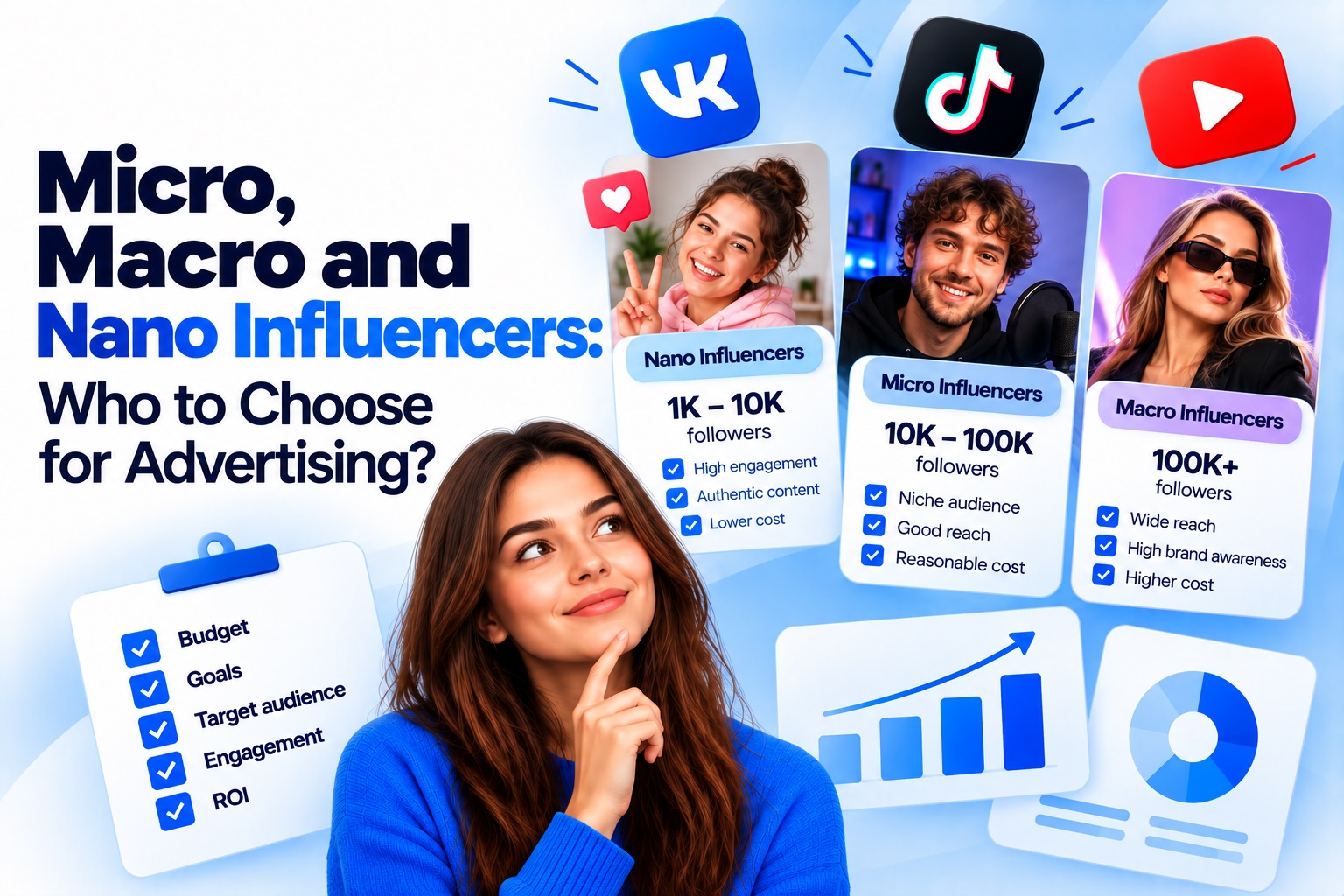
Micro-, macro- and nano-influencers: who to choose for advertising. Part 1 of 3.
Choosing a blogger for advertising often starts with a simple number – the number of subscribers. It seems logical: the larger the audience, the more potential customers.
In practice, everything is a bit more complicated.
A blogger with a million subscribers may bring fewer target customers than an author with 30 thousand. One will have huge reach but weak connection with the audience. The other will have a small community that really listens to their recommendations.
Therefore, in influencer marketing, it is important to choose not the largest blogger, but the one that fits the business task.
Who are nano-, micro-, macro- and mega-influencers
Influencers are conditionally divided by audience size: nano-, micro-, macro- and mega-influencers.
At the same time, there are no universal boundaries for these categories: different platforms, agencies and research use their own ranges.
| For practical work, you can refer to the following classification: | Category | Approximate audience size |
|---|---|---|
| Feature | Nano-influencer | up to 10k |
| Small, often very close community | Micro-influencer | 10–100k |
| Good balance of reach and engagement | Macro-influencer | 100k–1M |
| Significant reach | Mega-influencer | 1M+ |
Massive audience and high media potential
These values should be perceived as a guideline, not as a strict standard.
Much more important is another thing: who is behind the subscriber count and how well this audience matches the business.
Nano-influencers: small audience, high closeness
Nano-influencers work with small communities. These can be local authors, specialists, experts, representatives of narrow professional or thematic communities.
Their main advantage is not scale, but closeness to the audience.
Subscribers often perceive such an author not as a media celebrity, but as a person whose opinion can be trusted.
- When nano-influencers are particularly interesting
- for local businesses
- for niche products
- for small brands
- for testing new offers
for products with a narrow target audience
| for campaigns where recommendation is important, not mass reach. | Pros |
|---|---|
| Limitations | High closeness with the audience |
| Small reach | Narrow topic |
| Harder to scale quickly | Possible high engagement |
| Requires more placements | Often more budget-friendly |
| Need to carefully select authors | Good for local campaigns |
Limited audience scale
The main question when working with a nano-influencer: is their audience really your potential audience?
Micro-influencers: balance of reach and trust
Micro-influencers are one of the most interesting categories for commercial campaigns.
They already have a large enough audience to get noticeable reach, while maintaining relatively close communication with subscribers.
- For example, a blogger may specialize in:
- finance
- education
- technology
- sports
- cars
- travel
beauty
entrepreneurship.
For business, such specialization is often more valuable than the total number of subscribers.
Why micro-influencers are attractive
They allow combining several factors:
| relevant audience + sufficient reach + ability to test multiple authors. | Task |
|---|---|
| Potential of micro-influencers | Attracting target traffic |
| High | Product testing |
| High | Sales |
| High with proper selection | Awareness |
| Medium/High | Niche products |
| Very High | Local promotion |
High
This format is particularly interesting for companies that do not want to bet on one large blogger and prefer to distribute the budget among several relevant authors.
Macro-influencers: when scale matters
A macro-influencer can provide significantly greater reach per placement.
This is more of a media tool, especially if the task is to quickly deliver a message to a large audience.
- Macro-influencers can be useful for:
- launching a new product
- large-scale advertising campaign
- increasing awareness
reaching a new audience for the brand
creating mass demand.
But large reach also creates additional risk.
The wider the audience, the higher the probability that a significant part of it will not be potential customers.
Therefore, placement cost should be compared not only with the number of views, but also with the quality of the audience.
Mega-influencers: maximum reach
Mega-influencers operate at a scale comparable to large media platforms.
Their advantage is the ability to quickly ensure a large number of contacts with the brand.
But here it is especially important to understand the difference between media effect and direct sales.
If the task is to get several dozen high-quality leads in a narrow niche, the budget may prove more effective when working with a group of micro-influencers.
Comparison of influencer categories
| Criterion | Nano | Micro | Macro | Mega |
|---|---|---|---|---|
| Audience size | Small | Medium | Large | Very large |
| Reach | Low | Medium | High | Very high |
| Proximity to audience | Very high | High | Medium | Low/medium |
| Niche focus | Very high | High | Medium | Low/medium |
| Mass reach potential | Low | Medium | High | Very high |
| Ability to test many authors | High | High | Medium | Low |
| Placement cost | Usually lower | Medium | High | Very high |
| Approach for a narrow target audience | ⭐⭐⭐⭐⭐ | ⭐⭐⭐⭐⭐ | ⭐⭐⭐ | ⭐⭐ |
| Approach for mass reach | ⭐ | ⭐⭐ | ⭐⭐⭐⭐ | ⭐⭐⭐⭐⭐ |
What is more important: reach or audience quality?
For most performance campaigns, audience quality is more important than the absolute number of subscribers.
Let’s consider two advertising integrations.
| Indicator | Blogger A | Blogger B |
|---|---|---|
| Subscribers | 500 000 | 50 000 |
| Post reach | 120 000 | 25 000 |
| Audience relevance | Medium | Very high |
| Clicks | 1 000 | 900 |
| Leads | 25 | 45 |
| Customers | 5 | 12 |
Blogger A achieved almost five times greater reach.
But B brought more customers.
This does not mean that micro-influencers are always more effective than macro ones. It means something else:
audience size alone does not allow you to assess the value of an advertising placement.
How to choose a blogger category for your task
It is better to start not with the question “which blogger to choose?”, but with the question “what result does the business need?”
| Business task | Preferred category |
|---|---|
| Local recognition | Nano / micro |
| Narrow niche | Nano / micro |
| Hypothesis testing | Nano / micro |
| Sales | Micro / macro |
| Lead generation | Micro / niche macros |
| Product launch | Micro + macro |
| Mass awareness | Macro / mega |
| Image campaign | Macro / mega |
| Building expertise | Nano / micro / expert macros |
This is not a universal rule. The specific choice depends on the product, audience, budget, and platform.
Why several micro-influencers are sometimes better than one large one
Imagine an advertising budget of 300,000 RUB.
There are two options:
Option A: one large blogger for 300,000 RUB.
Option B: ten thematic bloggers for 30,000 RUB each.
In the first case, the company gets one large contact with one audience.
In the second – it tests several segments and authors.
| Parameter | 1 large blogger | 10 micro-influencers |
|---|---|---|
| Number of audiences | 1 | 10 |
| Formats | Limited by one author | Can be tested |
| Risk | High dependence on one placement | Distributed |
| Comparability | Low | High |
| Scaling | Through this author | Through the best authors |
| Analytics | Simpler | More complex, but more informative |
For a test campaign, the second approach can provide much more data.
After that, the budget can be redistributed in favor of those authors who showed the best results.
But the number of bloggers should not become an end in itself
Ten unsuitable bloggers are no better than one suitable one.
If the authors’ audiences are practically identical or do not match the product, increasing the number of placements will simply increase costs.
Therefore, it is more efficient to build a sequence:
audience analysis → author selection → testing → result analysis → scaling.
How to evaluate a blogger before advertising
Before placing content, it is worth looking not only at the number of subscribers.
Checklist
| What to check | What to pay attention to |
|---|---|
| Topic | Does it match the business |
| Audience | Who is actually subscribed |
| Geography | Does it match the sales zone |
| Age | Does it match the target audience |
| Reach | Average post metrics |
| Engagement | Reactions and comments |
| Dynamics | Are there any abnormal spikes |
| Advertising load | How much advertising is published |
| Previous integrations | How did the audience react |
| Content format | Is it possible to naturally present the product |
Separately, it is worth looking at several previous advertising integrations.
Sometimes the statistics look good, but ad posts consistently receive significantly less attention. This is an important signal when choosing an author.
How not to fall into the trap of “he has a million subscribers”
The number of subscribers is one of the most noticeable figures in a profile. That is why it is easy to start orienting too strongly on it.
But for business, another sequence is more important:
Subscribers → reach → target audience → clicks → leads → sales.
If significant loss occurs at any stage, the number of subscribers will no longer compensate for the problem.
For example, a million subscribers will not help if:
- most of the audience is in another country
- the product is designed for a different age group
- the blog topic does not match the offer
- advertising content does not generate interest
clicks are virtually absent.
How to distribute the budget among different categories
There is no universal percentage ratio for all companies.
But the budget can be divided according to the logic of testing and scaling.
For example:
| Stage | Approach |
|---|---|
| Micro-, macro- and nano-influencers: who to choose for advertising. Part 3 of 3. | Several micro and niche authors |
| Analysis | Comparison of cost and result quality |
| Scaling | Increasing budget for effective authors |
| Media stage | Engaging large influencers |
| Repeat placements | Working with authors who have already proven their effectiveness |
This approach reduces dependence on a single ad placement and allows making decisions based on actual data.
Micro-influencer or macro: which to choose?
If you need a precise answer, the choice depends on the task.
Choose micro-influencers if:
- a narrow target audience is important
- the product requires trust
- you need to test a hypothesis
- the budget is limited
- you need to compare several audience segments
leads and sales are important, not just reach.
Consider macro-influencers if:
- significant reach is needed
- a new mass-market product is being launched
- brand awareness is the priority
- the brand is ready to work with a higher cost per contact
the blogger’s audience truly matches the target audience.
Use a combination if:
you need to achieve both broad reach and targeted impact on the target audience simultaneously.
For example:
macro-influencer → wide reach
micro-influencers → more precise work with segments
The most important thing is not the category, but relevance
Sometimes an influencer marketing specialist faces a paradox: the client asks to find “large bloggers,” while their real task is to generate sales in a very narrow niche.
In such a situation, the right question sounds different:
“Where is the audience that can actually buy the product?”
The answer to this should determine the choice of influencers.
Because a good blogger for one brand may be completely useless for another.
FAQ
Who is more effective for advertising: micro- or macro-influencers?
There is no universal answer. Micro-influencers are often interesting for niche products and performance tasks, while macro-influencers are suitable for broad reach and increasing brand awareness.
How many subscribers should a good blogger have?
There is no fixed value. Audience alignment with the business, actual reach, engagement, and the author’s ability to drive desired actions are more important.
Is it worth working with multiple bloggers at once?
Yes, especially during the testing phase. Multiple placements allow comparing audiences, formats, and campaign economics.
Are nano-influencers suitable for business?
Yes. A small audience can be an advantage if it aligns well with the target group and actively interacts with the author.
How to understand which blogger will bring more sales?
It is impossible to guarantee results in advance. To assess potential, analyze the audience, reach, previous ad placements, engagement, topic, and economics. After launch, evaluate results based on clicks, leads, clients, and sales.
Which approach to choose Nova Media
In influencer marketing, there is no universal rule that “the bigger the blogger, the better the result.”
For one project, several micro-influencers may be the optimal solution; for another, a large industry expert; and for a third, a combination of different categories.
Therefore, the choice starts with the business goal and audience, and only then moves to platforms, bloggers, formats, and budget.
Nova Media helps build influencer marketing as a full-fledged promotion channel: from strategy definition and platform selection to organizing integrations and evaluating results.
Influencer Marketing Nova Media
Read also
Advertising with bloggers: how to choose a platform and get results
How to evaluate the effectiveness of blogger advertising: KPI, metrics, and result calculation
Native advertising with bloggers: how it works, formats, and costs
How to calculate the budget for blogger advertising: formulas, approaches, and examples